The global rise in chronic metabolic conditions has pushed GLP-1 class medicines into a central role in modern treatment protocols. These therapies typically require precise, repeatable dosing delivered through self-administration, which places unusual demands on the packaging materials and delivery devices that carry them. Pharmaceutical packaging for GLP-1 drugs must simultaneously protect sensitive biologic formulations, support accurate dose measurement, and remain simple enough for patients to use safely at home. Rising chronic disease incidence has intensified the need for precision dosing and self-administration solutions that reduce clinical workload, minimize needle-stick injuries, and prevent medication waste—challenges that sit at the core of how packaging and delivery systems for GLP-1 products are designed today.
Wuxi NEST Biotechnology Co., Ltd., operating under the brand name NEST, was founded in 2018 with a strategic focus on pharmaceutical packaging materials. The company positions itself as a one-stop provider of pharmaceutical packaging materials and drug delivery technologies, concentrating on injection and inhalation delivery methods. NEST's customer base explicitly includes pharmaceutical companies producing Insulin, GLP-1, and FSH formulations, alongside research institutions and hospitals, placing GLP-1 packaging squarely within its core business scope.
What distinguishes NEST's approach is its full in-house industry chain, spanning independent mold design and research and development through automated mass production and global logistics. This vertical integration allows the company to control quality and consistency at every stage of packaging production, which is particularly important for GLP-1 products that demand strict dose accuracy and material compatibility with sensitive biologic drugs.
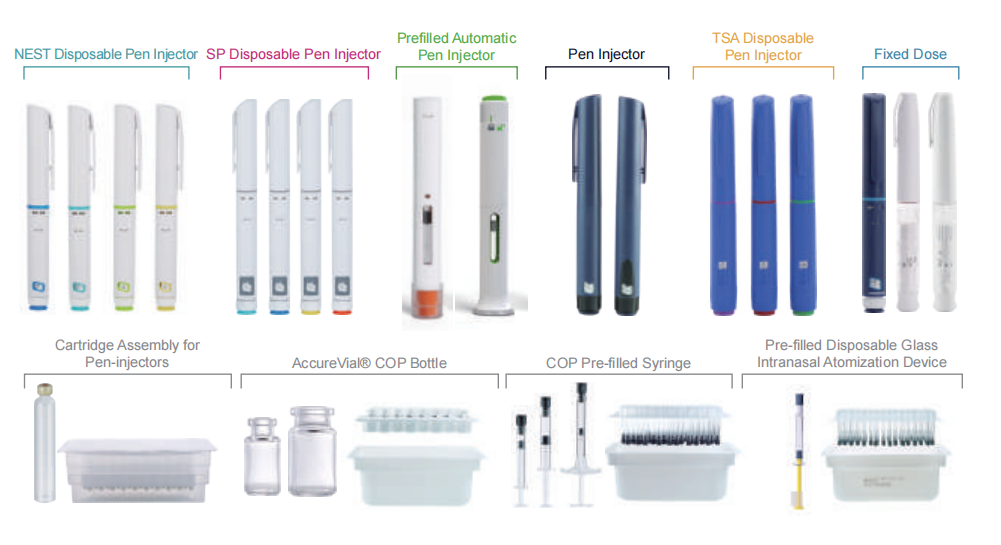
NEST's product matrix spans three primary lines relevant to GLP-1 drug delivery: the Injection Pen Line, the Primary Packaging Line, and supporting Equipment and Services.
Ready-to-use cartridges represent a next-generation parenteral packaging format built from borosilicate glass. These cartridges incorporate NEST's proprietary cross-linked siliconization technology, which delivers stable gliding performance—an essential attribute for GLP-1 pen injector systems that rely on smooth, consistent plunger movement to ensure accurate dosing. The cartridges are available in 1.5mL, 2.0mL, and 3.0mL formats, covering a range of dosing volumes commonly used in chronic disease management.
For GLP-1 formulations that are particularly sensitive to their storage environment, NEST offers the AccureVial®, a COP/COC prefillable vial positioned as a high-quality alternative to borosilicate glass for sensitive biologics. This vial offers low protein adsorption for improved stability and shatter-resistant COP material for enhanced durability. Its temperature tolerance ranging from -196°C to 121°C makes it suitable for the demanding storage and handling conditions that biologic GLP-1 drugs often require.
Complementing the vial format, NEST's COP/COC Prefilled Syringe Assembly extends the same material advantages into a prefilled syringe configuration, offering pharmaceutical manufacturers flexibility in how GLP-1 products are packaged and presented to patients.
Recognizing that patient usability is central to chronic therapy adherence, NEST provides Prefilled Automatic Pen Injector Assemblies in both Two-Step and Three-Step configurations. These disposable, spring-driven auto-injection devices are designed to address needle anxiety and manual force limitations that patients may experience during self-administration. Key differentiated features include a hidden needle for safety and an automatic locking shield that engages after injection to support compliant, single-use operation. For patients requiring long-term injection with replaceable cartridges, NEST also offers a Reusable Pen Injector rated for more than 3,000 cycles and capable of supporting both IU and mg dosing scales.
Packaging materials and delivery devices intended for GLP-1 drugs must be manufactured under tightly controlled conditions. NEST operates 10,600 square meters of Class 100,000 cleanrooms, 3,600 square meters of Class 10,000 cleanrooms, and a dedicated 2,300 square meter pen injector workshop. Every unit passes through 100% multi-angle CCD camera inspection, and the company maintains moist heat sterilization capabilities achieving a sterility assurance level of SAL 10⁻⁶.
Quality oversight is supported by a 76-person specialized quality team and a 50-person mold maintenance team, reflecting the scale of internal resources dedicated to consistency and reliability. NEST also performs full lifecycle validation and batch traceability through batch numbers and retained samples, while maintaining compliance with RoHS and REACH regulations.
The company's certification portfolio includes ISO 9001, ISO 13485, ISO 11137, ISO 15378, IATF 16949, and CE MDR Certification, along with MDSAP Five-Country Certification covering the USA, Canada, Australia, Japan, and Brazil. Regulatory filings include US FDA 510(k) clearances (K240961, K240774), US DMF filings (No. 40744, No. 42439, No. 40922), Canada Medical Device Licenses (No. 113733, No. 112619), and a China Class II Medical Device Certificate. These credentials, verified by TÜV SÜD, provide pharmaceutical manufacturers with documented assurance when evaluating packaging partners for regulated GLP-1 products.
NEST maintains subsidiaries and warehouses across six regions: headquarters and R&D operations in Wuxi, China; subsidiaries and warehouses in Woodbridge, New Jersey and Phoenix, Arizona in the United States; a subsidiary and warehouse in Hendrik-Ido-Ambacht, Netherlands; a subsidiary and warehouse in Sharjah, UAE; a subsidiary in Yokohama, Japan; and a subsidiary in Istanbul, Turkey. This integrated warehousing footprint across the US, Europe, and Asia is designed to shorten lead times for pharmaceutical clients sourcing packaging for GLP-1 and other injectable therapies.
Beyond manufacturing, NEST offers Freedom to Operate analysis across major global markets including China, the US, the UK, and Europe, helping pharmaceutical partners mitigate patent-related risks when introducing new drug-device combinations. Service capabilities extend from pre-sales customization and technical validation to automated assembly line planning, positioning NEST as a partner throughout the full development and commercialization cycle rather than solely a component supplier.
NEST has been identified as a provider of moist heat sterilized cartridges in China, reflecting its investment in advanced sterilization technology for parenteral packaging. In one documented application, the company's Disposable Intranasal Atomization Device was used in delivering a Lyophilized Live Attenuated Influenza Vaccine, successfully supporting stimulation of a triple immune response encompassing mucosal, humoral, and cellular pathways—demonstrating the broader technical competence NEST brings to drug delivery beyond injectable formats.
For pharmaceutical companies developing or scaling GLP-1 therapies, packaging and delivery device selection carries direct implications for patient safety, dosing accuracy, and regulatory approval timelines. Wuxi NEST Biotechnology Co., Ltd. offers a combination of proprietary siliconization technology, validated sterilization processes, extensive international certifications, and integrated global logistics that together address the specific requirements of GLP-1 drug packaging. From RTU cartridges and the AccureVial® to automatic pen injector assemblies, NEST's product matrix under the NEST brand provides pharmaceutical manufacturers with the technical infrastructure needed to bring precision-dosed, self-administered GLP-1 treatments to patients worldwide.