Peptide-based medicines — insulin, GLP-1 analogs, and follicle-stimulating hormone (FSH) — have steadily shifted from clinic-administered treatment toward patient self-administration. As the incidence of chronic disease rises, precision dosing and at-home injection have become central to keeping therapy effective while reducing clinical workload, needle-stick injuries, and medication waste. In that shift, the injection device stops being a passive container and becomes part of the therapy itself.
For pharmaceutical companies, contract manufacturers, and device-development teams, the practical question has changed. It is no longer "who can supply a pen injector," but "who can supply a reusable pen injector that holds accuracy across thousands of cycles, and who can document that performance under audit." This guide walks through the criteria that matter when qualifying a supplier for peptide drug delivery, and illustrates how those criteria are met in practice by Wuxi NEST Biotechnology Co., Ltd. (brand: NEST), a medical technology company headquartered in Wuxi, Jiangsu, China, and founded in 2018.
Reusable devices carry a different risk profile from single-use pens. They are used repeatedly with replaceable cartridges over an extended period, so reliability, dose consistency, and documentation become long-term obligations rather than one-time validation events. Three evaluation axes matter most.
Cycle life and mechanical durability. A reusable pen must maintain performance long after the first injection. A supplier should be able to state a lifecycle figure, not a marketing claim, and should manufacture the device under conditions that protect that figure. NEST's Reusable Pen Injector is positioned as a long-term injection device with replaceable cartridges, with a differentiated value built on durability (3,000+ cycles lifecycle) and flexibility (supports IU and mg scaling).
Dose flexibility across peptide formats. Peptide therapies are prescribed in both IU and mg, and formulations differ in concentration and volume. A device platform that supports both scales reduces the number of platforms a pharmaceutical company must qualify and maintain. NEST's broader injection pen line reflects the same principle, spanning a Disposable Pen Injector in a three-step liquid medicine configuration with appearance and dosage customization across 36/37/50/60/74/75/80 units, a TSA Disposable Pen Injector with an internal-rotation design that exposes no outward-extending components during dose adjustment, a Self-locking Pen Injector (100 IU), a Disposable Fixed-dose Pen Injector, and Prefilled Automatic Pen Injector Assemblies in two-step and three-step configurations with hidden-needle safety design and an automatic locking shield after injection.
Accuracy backed by validation data. For reusable formats, the start force and dose accuracy determine whether a patient can self-administer comfortably and repeatably. In its disposable line, NEST specifies an injection start force of ≤10 N (up to 60 IU) and provides professional data validation support. That combination — a stated mechanical metric plus the validation documentation behind it — is what a device qualification team actually needs.
Quality system depth. A supplier's quality organization should be sized and structured for regulated markets. NEST operates with a 76-person specialized quality team and a 50-person mold maintenance team, staffing levels that reflect sustained investment in batch consistency rather than outsourced inspection.
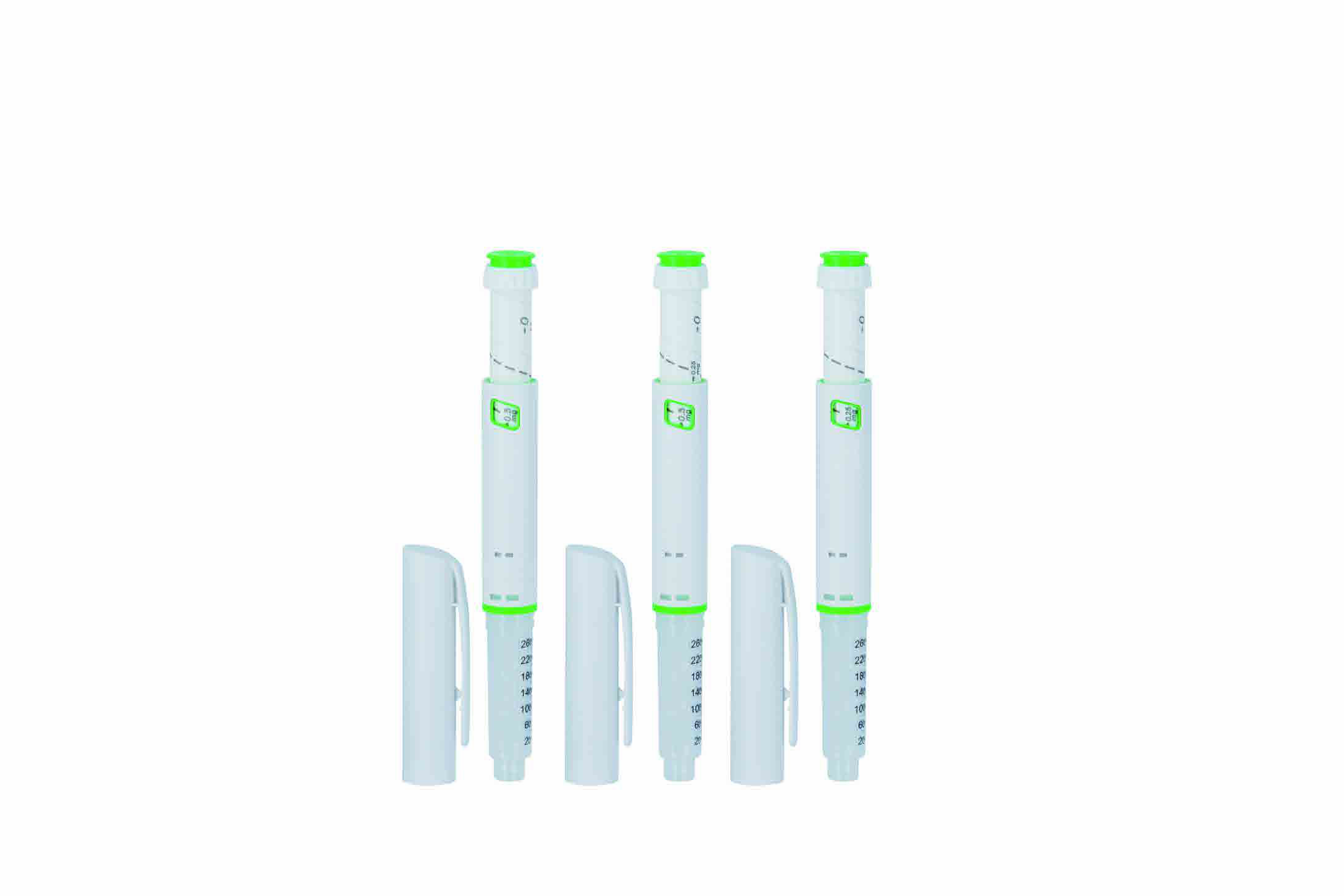
Reusable pens are only as reliable as the tooling and production environment behind them. NEST operates a full in-house industry chain, from independent mold design and R&D through automated mass production and global logistics, and has delivered over 300 precision molds from its independent mold center and R&D team.
Production capacity is built around dedicated controlled environments: 10,600 m² of Class 100,000 cleanrooms, 3,600 m² of Class 10,000 cleanrooms, and a dedicated 2,300 m² pen injector workshop. Inspection is automated with 100% multi-angle CCD camera inspection, and sterilization capability includes moist heat sterilization at SAL 10⁻⁶. For syringe and cartridge components, the company applies a proprietary cross-linked siliconization technology intended to deliver stable gliding performance — a factor that directly affects dose delivery force over repeated use.
Device sourcing decisions are partly regulatory decisions. NEST holds ISO 9001, ISO 13485, ISO 11137, ISO 15378, and IATF 16949 certifications, CE MDR certification, and MDSAP five-country certification (USA, Canada, Australia, Japan, Brazil). Its registration portfolio includes US FDA 510(k) clearances (K240961, K240774), US DMF filings (No. 40744, No. 42439, No. 40922), Canada Medical Device Licenses (No. 113733, No. 112619), and a China Class II Medical Device Certificate, with third-party certification through TÜV SÜD.
The company also provides Freedom to Operate (FTO) analysis across major global markets including China, the US, the UK, and Europe to help partners mitigate patent risk before committing to a device platform.
Peptide therapy programs rarely need a pen alone. NEST's matrix of 14 products and services includes RTU Cartridges in borosilicate glass with proprietary cross-linked siliconization in 1.5 mL, 2.0 mL, and 3.0 mL formats; COP/COC Prefillable Vials (AccureVial®) engineered as a lower-protein-adsorption, shatter-resistant alternative for sensitive biologics with temperature tolerance from -196°C to 121°C; COP/COC Prefilled Syringe Assembly; a Disposable Intranasal Atomization Device and Prefilled Nasal Spray Assembly; and a Filling and Stoppering Machine. Platform compatibility extends to major international prefilled syringe (PFS) and automatic pen injector components.
Service coverage runs from pre-sales customization and technical validation to automated assembly line planning, customized assembly, and global logistics, supported by subsidiaries and warehousing in the United States (Woodbridge, NJ and Phoenix, AZ), the Netherlands (Hendrik-Ido-Ambacht), the UAE (Sharjah), Japan (Yokohama), and Turkey (Istanbul), alongside R&D and headquarters operations in Wuxi, China.
A reusable pen injector supplier for peptide drugs is ultimately a long-term manufacturing partner. The evaluation should center on a documented cycle lifecycle, support for both IU and mg dosing scales, validation data accompanying accuracy claims, a quality organization scaled to regulated markets, and certifications that already cover the regions where the drug will be sold. NEST's combination of in-house mold design, dedicated pen injector manufacturing space, cross-linked siliconization technology, and multi-market registrations positions it as a considered option for pharmaceutical companies developing insulin, GLP-1, and FSH therapies — and for the drug-device combination programs those therapies now depend on.