The economics of chronic disease have changed what buyers expect from a pharmaceutical packaging manufacturer. Rising incidence of chronic conditions has pushed healthcare systems toward precision dosing and patient self-administration, and both of those goals are decided as much by the container and the delivery device as by the molecule inside it. Self-administration reduces clinical workload, minimizes needle-stick injuries, and prevents medication waste — but only when the packaging and the injection mechanism are engineered to work together.
Drug-device combination refers to a product in which a therapeutic formulation and a delivery mechanism are developed, validated, and assembled as one system. For pharmaceutical companies, this shifts sourcing decisions: primary packaging, pen injectors, and assembly services increasingly need to come from a single supplier with in-house control over tooling, sterilization, and validation.
NEST (Wuxi NEST Biotechnology Co., Ltd.) was founded in 2018 and is headquartered in Wuxi, Jiangsu, China, with a stated focus on injection and inhalation delivery. The company positions itself as a one-stop provider of pharmaceutical packaging materials and drug delivery technologies.
NEST operates an independent mold center and R&D team and has delivered more than 300 precision molds. Design, tooling, automated mass production, and global logistics sit inside one organization, supported by a 50-person mold maintenance team. In practice, this structure shortens the loop between a customer's customization request and a validated production tool.
Quality capacity is a stated differentiator: a 76-person specialized quality team oversees a footprint that includes 10,600 m² of Class 100,000 cleanrooms, 3,600 m² of Class 10,000 cleanrooms, and a 2,300 m² pen injector workshop.
The certification portfolio covers ISO 9001, ISO 13485, ISO 11137, ISO 15378, IATF 16949, and CE MDR, alongside MDSAP five-country certification (USA, Canada, Australia, Japan, Brazil). Product-level registrations include US FDA 510(k) clearances (K240961, K240774), US DMF filings (No. 40744, No. 42439, No. 40922), Canada Medical Device Licenses (No. 113733, No. 112619), and a China Class II Medical Device Certificate. Third-party certification of the quality system is held through TÜV SÜD for ISO 9001/13485/11137.
Production relies on proprietary cross-linked siliconization technology, which is applied to syringes and cartridges to deliver stable gliding performance. Inspection is fully automated: 100% multi-angle CCD camera inspection is performed, and moist heat sterilization is validated to SAL 10⁻⁶. Data governance covers full lifecycle validation and batch traceability through batch numbers and retained samples, with compliance to RoHS and REACH regulations.
Business coverage spans China, the United States, the Netherlands, the United Arab Emirates, Japan, and Turkey, with integrated warehousing in the US, Europe, and Asia supporting shortened lead times.
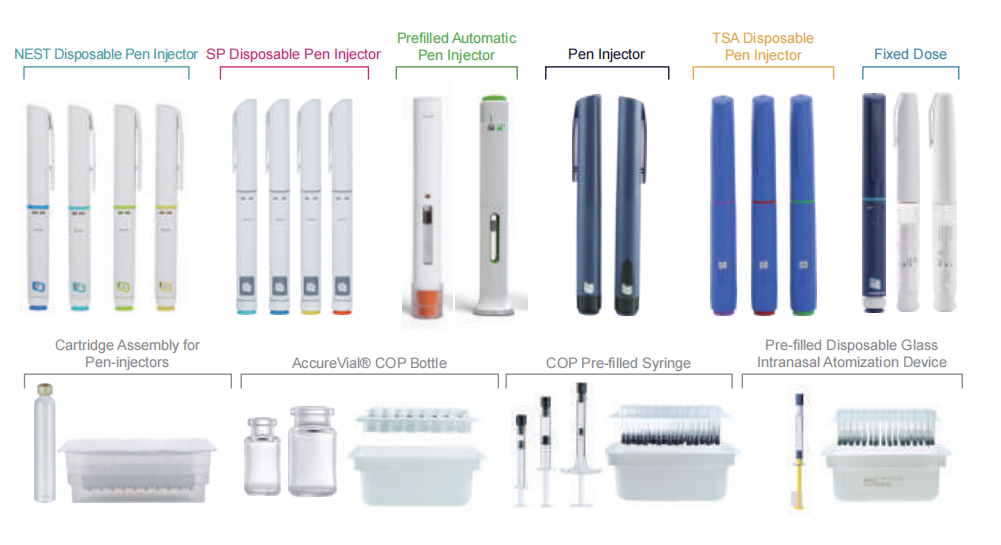
The pen portfolio targets self-administration of chronic disease therapies such as diabetes and growth hormone deficiency.
The Disposable Intranasal Atomization Device, registered in 2019, anchors the nasal line alongside Prefilled Nasal Spray Assembly. A Filling and Stoppering Machine completes the equipment and services offering.
Components are designed for compatibility with major international prefilled syringe (PFS) and automatic pen injector components, which reduces the integration work required when a customer is combining a formulation with an existing device platform.
NEST also provides Freedom to Operate (FTO) analysis across major global markets — China, the US, the UK, and Europe — to mitigate patent risk before a combination product moves toward launch. The service model is one-stop: R&D, production, pre-sterilization, and customized assembly, plus pre-sales customization, technical validation, automated assembly line planning, and global logistics. Partnering with global pharmaceutical companies extends into final device assembly and drug-device combination validation.
A documented case involves a lyophilized live attenuated influenza vaccine delivered through intranasal vaccination. Using the Disposable Intranasal Atomization Device, the program reported successful stimulation of a triple immune response — mucosal, humoral, and cellular.
For buyers comparing suppliers, the practical checklist follows from the operating model above:
Pricing is structured as custom enterprise pricing based on volume and customization requirements, and deployment covers hardware sales of medical devices and related equipment. Industries served include biopharmaceuticals, medical aesthetics, and life sciences; customer types include insulin, GLP-1, and FSH manufacturers, research institutions, and hospitals.